THEMATIC READER
Rabbis & Teachers · Part 2
This reader combines 9 shorter encyclopedia entries into one continuous, searchable document. Each original title has a direct link and downloadable source text.
Rabbi Yissachar Dov
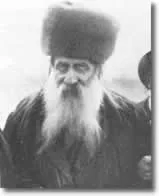
" There could be, before the arrival of Mashiach, that the Satan should succeed, and the evildoers should get a State in the Land of Israel. Their state would be a big danger for every Jew in material and spiritual matters.
Rabbi Yitchok Hutner
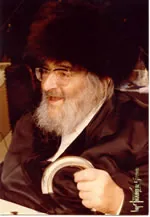
Rosh Hayeshiva of Mesivta Rabbi Chaim Berlin - Kolel Gur Aryah
Quotes from an article by Rabbi Hutner published in "The Jewish Observer", October, 1977 explaining the Holocaust:
Public Opinion vs. Truth
Before we explore the second of the new directions in detail, it is important to establish a clear distinction between any common approach to world events and daas Torah -- a Torah view of the world, "Public opinion" and any but the Torah approach is by definition colored by outside forces, subjective considerations and the falsehood of secular perspective.
An example of how public opinion can be molded -- indeed, warped -- at the whim of powerful individuals can be taken from a study of Russian history textbooks published during the respective reigns of Lenin, Stalin and Khrushchev. During each period, the textbooks hail the then-current leader to the exclusion of all his predecessors as the savior of Russia and hero of his people. Undoubtedly, "public opinion" during each period, once children's minds had been suitably molded, reflected the thinking and wishes of the state. While more subtle in form, this ability to direct public opinion exists in democratic countries as well. Thus, we already pointed out at the beginning that we must make every effort to free ourselves from the powerful grip of public opinion, and must be ever on our guard that our opinions of the true nature of world events will be shaped only by Torah views as seen through Torah eyes.
Sadly, even in our own circles, the mold for shaping public opinion lies in the hands of the State of Israel. An appropriate example of this dangerous process of selectively "rewriting" history may be found in the extraordinary purging from the public record of all evidence of the culpability of the forerunners of the State in the tragedy of European Jewry, and the sub-situation in is place of factors inconsequential to the calamity which ultimately occurred.
To cover its own contribution to the final catastrophic events, those of the State in a position to influence public opinion circulated the notorious canard that Gedolet Yisroel were responsible for the destruction of many communities because they did not urge immigration. This charge is, of course, a gross distortion of the truth, and need not be granted more dignity than it deserves by issuing a formal refutation. However, at the same time as the State made certain to include this charge as historical fact in every account of the war years, it successfully sought to omit any mention of its own contribution to the impending tragedy. While the State omitted in its own version of history is the second of the above-mentioned new directions in recent Jewish history. It is that phenomenon which we must now examine.
"The Jewish Observer", October, 1977, page 7.
Tochocha vs. Specific Guilt
For other reasons, too, one must be careful of sudden and popular "awakenings" to different aspects of Jewish history, such as "Holocaust studies."Nachum Goldmann, head of the only international secular Jewish organization not directly subservient to the Jewish State, has stated that the weakening of sympathy for the State was the result of a lengthy period of time after the Holocaust having passed and the resultant forgetting by the world at large. Undoubtedly, this State, taking advantage of the arbitrary figure of thirty years, sought to reawaken interest in what it now termed the Shoah to regain some of that lost sympathy of the late 40's and 50's.
"The Jewish Observer", October, 1977, page 9.
Rabbi Yitzchock Zev Soloveitchik
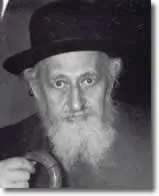
At an assembly of various rabbis in Jerusalem in the 1950s, a proposal was raised from the ranks of rabbis serving in Jewish religious schools (yeshivas) as to whether it was permissable and desirable for those schools to accept funding from the Zionist government. One of the greatest rabbis of the generation, Rabbi Yitzchak Zev Soleveitchik, pronounced his opposition to the proposal, and later wrote a letter in which he made the following statement:
From Lo Sasur (Thou shalt not depart) Page 37, Declaration and Letters, Document 13:
A letter written by the late Rabbi Yitzchak Ze’ev Soloveitchik in 1948 regarding accepting money from the Zionists for education.
Dear Rabbi Meir Karelitz:
I became angry to hear that at the meeting of heads of yeshiva schools held last week in Jerusalem it was decided to agree to the proposal that those schools accept funding from the United Fund administered by the Zionists, meaning that the keys to all the yeshiva schools should be transmitted to the Zionists, and that they will rule over the schools – which is what the Zionists have sought for many years.
In my opinion we must resist this proposal with self-sacrifice in all ways possible, because it is a proposal to violate the Torah, against which we must engage in self-sacrifice.
We must not worry about the possible loss of funding for our schools, which might only be for a short time. I contacted Rabbi Yehuda Finkel, and today he gave me his answer since I did not attend. He told me that the majority of the rabbis decided to accept the proposal.
__However, no attention should be paid to this!__
This is because the Torah does not belong to the heads of the yeshivas, and it is requirement to protest, struggle and resist their decision. Therefore, I am asking you to correct the distortion as soon as possible, because I heard that there is supposed to be a decision about this in Tel Aviv today.
G-d forbid this should occur among the Jewish People to transfer the keys of the Torah to those who violate it and fight against it!
I hope you do all you can to make sure the proposal is not implemented, and I will remain your friend.
Yours truly, 17 Av 5708 – 22 August 1948 Yitzchak Ze’ev, son of Rabbi Chaim Halevi Soloveitchik
To read the original Hebrew document, HERE
After Reb Velvel learned that at the convention in Mariband they had discussed the Jewish state he was very disturbed and said:
“How can these small rabbis and heads of yeshivas take upon themselves the determination of things dealing with life and death? It is obvious that the partition will bring with it the anger and hostility of the Arabs and other nations of the world. This whole thing touches on the shedding of blood. HOW DO THEY HAVE THE ARROGANCE TO MAKE JUDGEMENTS DEALING WITH LIFE AND DEATH?”
When asked: aren't we to pray for them, in order they should repent from their evil ways? He replied: three times a day in the prayer against the atheists we pray that they should be destroyed.
He also said: "The Agudah is nothing, just money."
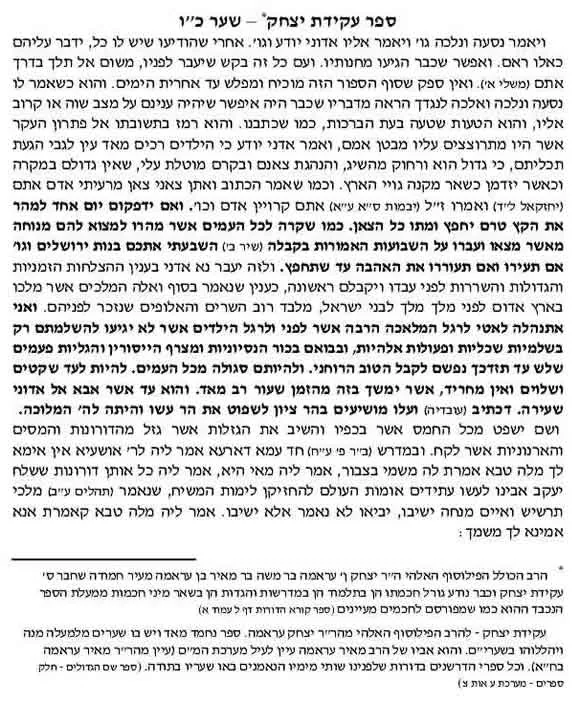
Rabbi Yitzchok Aramah
Rabbi Yitzchak Aramah was a great scholar in Spain prior to the expulsion. He was born there in 1420 and served as the chief rabbi of the city of Catalayud. He later passed aware in the Italian city of Naples in 1494 after the expulsion. He was renown for his works on Jewish philosophical matters, and one of his most famous works was called "Akeidas Yitzchak", a commentary on the Torah.
In this book, in chapter 26, Rabbi Yitchak Aramah states that the Decree of Exile for the Jewish People is so serious that even if the Jewish People were to terminate the Exile from the Holy land ONE DAY before the willing of G-D, the entire People would be in great danger by virtue of having violated the prohibition of ending the Exile as discussed in the Talmudic Tractate Kesuboth 111.
Rabbi Yosef Chaim Sonnenfeld
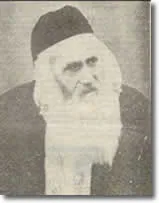
Leader of the Orthodox Jewish community in Jerusalem and a staunch anti Zionist. Around 75 years ago he participated together with the martyr Professor Yaakov Yisroel DeHaan (later murdered by the Zionists for his participation) in a delegation which visited King Hussein, his sons Faisal the King of Iraq and the Amir Abdullah, in order to lucidly present to them the position of the G-d-fearing Jewish community. The Jewish delegation clarified unequivocally that Torah Jewry is totally opposed to the Zionist sovereignty over the Holy Land. Rabbi Sonnenfeld later established the anti-Zionist Rabbinical court of the Eidah Hacharedis and was appointed as its head and Chief Rabbi by the Orthodox community in Jerusalem, this court standing in opposition to the Zionist puppet "Rabbinical court" and its "Chief Rabbis".
[[For more details on this event, read this article, A Historical Event from the Life of the Gaon Rav Yosef Chayim Sonnenfeld (Z”tl) on the Fifty First Anniversary of his Death (19 Adar 5692) March 27, 1932.]
After the disorders in Eretz Yisroel in 1929, the Chief Rabbi of the Orthodox Jewish Community, Rabbi Yosef Chaim Sonnenfeld, zt"l, issued a touching appeal to the Arab population to live in peace with the Jewish community, and assuring them that the Jewish people have no designs on the Temple Mount nor Arab properties.
This appeal, presented in English translation, as printed in Arabic in the leading Arab newspaper as well as in Loshon Kodesh in the Agudah weekly, Kol Yisroel on November 22, 1929. READ HIS APPEAL
Rabbi Sonnenfeld stated in his public declaration "Words of Truth and Peace" printed in issue number 6 of the Jewish Guardian, volume number I. as follows:
"The Jews do not want, in any way, to take that which isn't theirs. And they certainly do not want to contest the rights of the other inhabitants to the places held by them which they regard with honor and consider holy. And in particular there is no foundation to the rumor that the Jews want to acquire the Temple Mount. On the contrary, from the time that, because of our sins, we have been lacking the purity required by the Torah, it is forbidden for any Jew to set foot upon the grounds of the Temple Mount, until the coming of the righteous Messiah, who with the spirit of the L-rd which will hover over him, will rule righteously, for the good of all creation, and will return to us the purity required by the Torah".(Ibid, p.3).
Rabbi Yosef Chaim Sonnenfeld of blessed memory (center) with President Thomas Masaryik of Czechoslovakia (to left of Reb Yosef Chaim) while visiting Meah Shearim Jerusalem, April 1927.
External links
- Read English translation of the Arabic memorandum submitted to King Hussein of the Hejaz, great-grandfather of the present King Hussein of Jordan, by Rabbi Yosef Chaim Sonenfeld and
- Dr. Yackov Yisroel DeHaan, together with a delegation that visited the Monarch upon his visit to King Abdullah in Shuni -Trons - Jordan.
- READ MORE on the meeting of Rabbi Sonnenfeld with King Hussein.
Rabbi Yosef Karo
One of the most authoritative personalities in the history of Rabbinic writings, Rav Yoseif Karo was born in 1488. His main work was the Beit Yoseif, a commentary on the Tur. This work was then published in digest form as the Shulchan Aruch. Additionally, he wrote a commentary on Yad Chazakah of Rambam known as the Kesef Mishna, and a set of responsa, Avkat Rocheil is attributed to him as well. He passed away in Israel in 1575.
Rabbi Yosef Tzvi Dushinsky
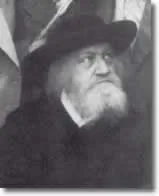
Read Excerpts of the 18 page document of written testimony submitted in person to the United Nations Special Committee in Palestine Wednesday, July 16, 1947 by the Chief Rabbis of the Ashkenasic Jewish Community, Rav Yosef Zvi Dushinsky and Rav Zelig Ruven Bengis of blessed memory.
CLICK HERE to read his first statement to the United Nations July, 1947.
When in mid November of 1947, it became evident that through zionist and Communist pressure the United Nations would vote for the partition of Palestine into Jewish and Arab states, Rav Dushinsky appealed, in the name of 60,000 Jewish Orthodox residents, to the United Nations by cable and a memorandum following, that Jerusalem should not be included in the Jewish state and should be given international status.
CLICK HERE to read the contents of his cable and memorandum to the United Nations in November, 1947.
Rabbi Dushinsky giving oral testimony to the United Nations Special Committee on July 16, 1947. Sitting next to him is Rabbi Bengis.
DOCUMENT NO. A-AC 14-44 Communications received by Ad Hoc Palestine Committee, November 18, 1947
Rav Hai Gaon
One of the last Geonim, Rav Hai was the head of the academy at Pumbedeita, Babylonia and lived from 969 until 1038. He authored both a commentary on the Talmud as well as a collection of responsa, plus several other smaller works on focused topics. His father, Rav Sherira Gaon, was his teacher and predecessor as head of the academy. His students included Rabbeinu Chananel and Rav Nissim, the head of the academy at Kairouan.
Rav Simcha of Vitri
Rav Simcha of Vitri, France, who died in 1105, authored this halachic work. It focuses mainly around the daily and Shabbat prayer services, and includes halachic decisions from his teacher Rashi or from other early scholars. It also includes halachic decisions on issues of kashrut, family purity, tefillin, mezuzah, and ethics.